한 실험 연구는 White-coa t blood pressure effect를 조사하기 위해 혈압과 sympathetic neurla activity에서 지속적인 모니터링 방법을 사용했습니다.
Sympathetic neurla activity는 백의고혈압을 매개하는 것으로 여겨집니다. 조사자는 평균 혈압이 153/101mmHg인 최근 찾은 치료를 받지 않은 고혈압 환자 18명을 대상으로 이 연관성을 조사하였습니다.
본 실험 프로토콜에서는 지속적인 beat-to-beat BP와 심박수를 환자의 손가락으로 측정하였으며, peroneal nerve에서는 Skin sympathetic nerve activity를 기록하였습니다. 10분 baseline beat-to-beat 기록 후 자동화된 Omronarm BPdevice는 다음 10분 동안 혈압을 여러 번 측정했습니다. 각 환자에서 이것은 2회 실시되어 1회는 임상의가 있을 때, 또 1회는 임상의가 없을 때였습니다.
임상의가 없는 경우의 평균 혈압은 20분간 계속해서 감소했습니다.(146/97 → 140/93) 반대로 임상의가 존재했을 때 평균 혈압은 148/98에서 155/106으로 계속 상승하였습니다. 임상의가 되었을 때 대부분의 혈압은 automated arm cuff가 부풀면 발생했습니다. 심박수와 skin sympathetic nerve acitivy는 BP 소견과 일치했습니다. 이들은 임상의가 없을 때 감소하고 임상의가 있을 때 증가했습니다.
※※ 본 연구는 가방의 고혈압 효과에 대한 추가적인 증거를 제공합니다. 일부 환자에서 임상의가 존재하며 동시에 BP cuff가 부풀어 오르면 sympathetic neural activity와 혈압반응을 자극합니다. 이러한 현상이 심혈관 리스크의 지표가 되는 정도에 대해 계속 논의되고 있습니다.
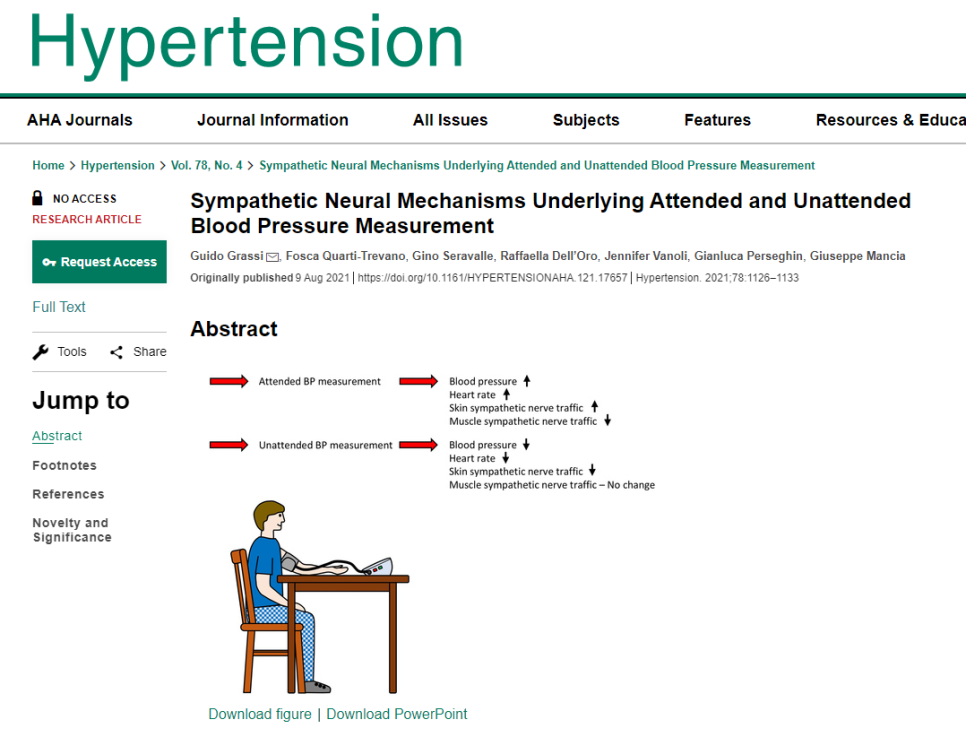
Whether blood pressure (B P) values differ when BP is measured with or without the presence of a doctor (attended and unattended BP measurements) is controversial, and no information exists on whether and to what extent neurogenic mechanisms participate at the possible BP differences between these measurements. In this study, we assessed continuous beat-to-beat finger systolic BP and diastolic BP, heart rate, muscle, and skin sympathetic nerve traffic (microneurography) before and during BP measurement by an automatic device in the presence or absence of a doctor. This was done in 18 untreated mild-to-moderate essential hypertensive patients (age, 40.2±2.8 years, mean±SEM). During attended BP measurement, there was an increase in systolic BP, diastolic BP, heart rate, and skin sympathetic nerve traffic and a muscle sympathetic nerve traffic decrease, the peak changes being +5.3%,+8.4%,+9.4%,+30.9%, and -15.2%, respectively (P<0.05 for all). In contrast, during unattended BP measurement, systolic BP, diastolic BP, heart rate, and skin sympathetic nerve traffic were modestly, albeit in most instances significantly, reduced, whereas muscle sympathetic nerve traffic remained almost unchanged. During unattended BP measurement, peak systolic BP was 14.1 mm Hg lower, peak heart rate was 10.6 bpm lower, and peak skin sympathetic nerve traffic was 8.5 bursts/min lower than the peak values detected during attended BP measurement. Thus the cardiovascular and neural sympathetic responses to the alerting reaction elicited by BP measurement in the presence of a doctor are almost absent during unattended BP measurement, during which , if anything , a modest cardiovascular sympathoinhibition occurs . This has important implications for comparison of studies using these different BP measurement approaches as well as for decision concerning threshold and target BP values for treatment .
REF . NEJM journal watchHypertension . 2021 ; 78 : 1126 – 1133